How to Start Bolt Manufacturing in India 2025
How to start a bolt manufacturing business in India. Machines needed, investment, raw materials and setup guide by Samrat Machine Tools Ludhiana.
HOW TO STARTBOLT MANUFACTURING BUSINESS INDIA
Manjit Singh
3/13/20264 min read
If you are planning to start a nut and bolt manufacturing business in India, you are entering one of the most stable and in-demand industries in the country. Bolts and fasteners are used in every sector — construction, automobiles, railways, agriculture equipment, furniture, and industrial machinery. India is one of the world's largest consumers and exporters of fasteners, and the demand is only growing.
This guide walks you through everything you need to know — from the machines required, to raw materials, investment, and what kind of production output you can realistically expect.
Why Bolt Manufacturing is a Good Business in India
India's fastener industry is valued at over ₹20,000 crore and continues to grow year on year, driven by infrastructure projects, automobile production, and manufacturing under the "Make in India" initiative. Small and medium bolt manufacturers across Punjab, Gujarat, Maharashtra, and Tamil Nadu have built profitable businesses supplying to local industries, government projects, and export markets.
The business has several advantages:
Raw material (wire rod) is widely available across India
Demand is consistent — every factory and construction site needs fasteners
Machines have long operational life (15–25 years with proper maintenance)
You can start small with 2–3 machines and scale up gradually
Export opportunities exist in Kenya, Bangladesh, Sri Lanka, the Middle East, and Southeast Asia
Machines Required for a Bolt Manufacturing Plant
A complete bolt manufacturing production line requires the following machines, used in sequence:
1. Wire Straightener and Feeder
The first step is feeding coiled wire rod into the production line. The wire straightener removes the natural curl from the coil and the feeder pushes it into the heading machine at a controlled speed. The wire diameter is set according to the bolt size you want to produce.
2. Cold Forge Header Machine (Cold Heading Machine)
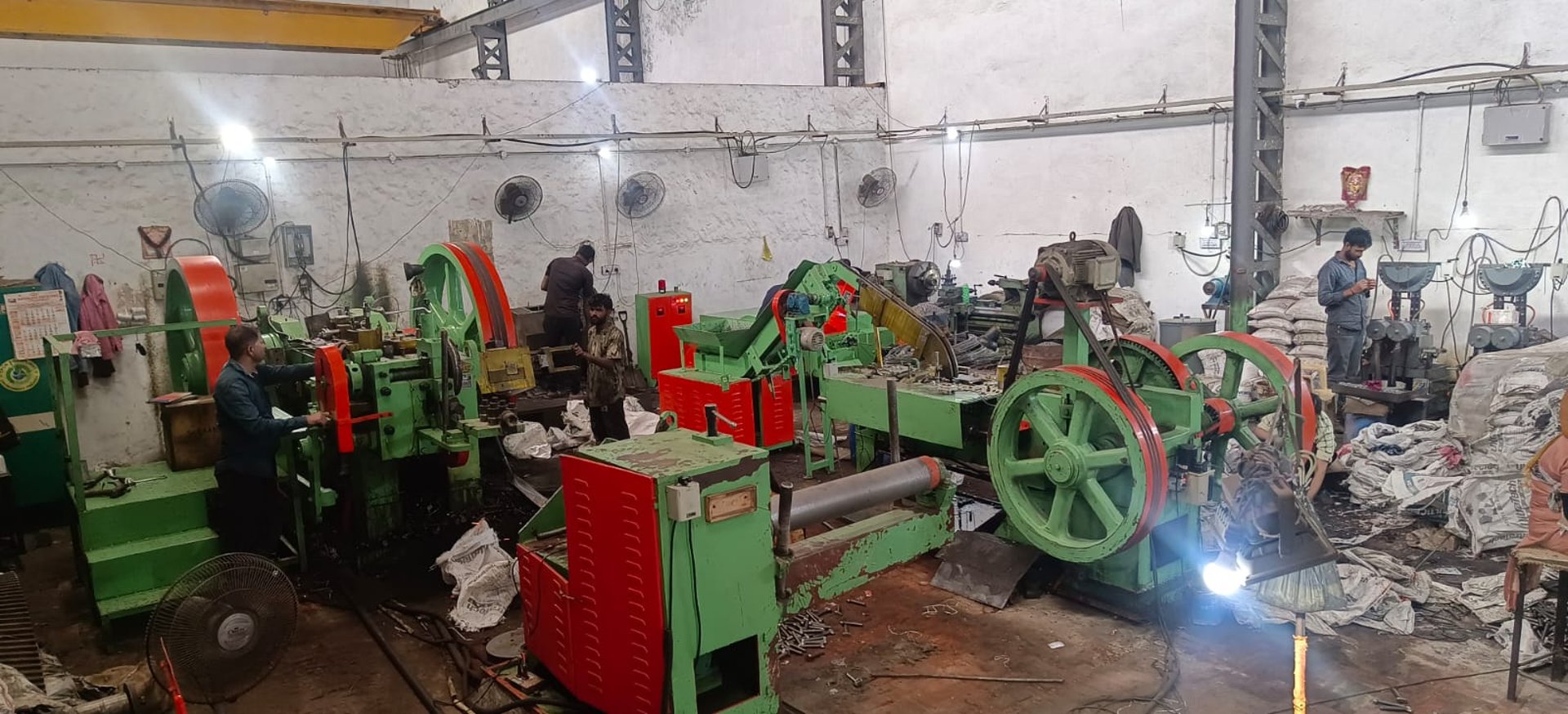
This is the most important machine in the line. The cold forge header machine forms the bolt head — hex, square, or round — by applying high-pressure cold forging. No heating is required, which makes the process fast, energy-efficient, and precise.
Cold heading machines are available in automatic and semi-automatic configurations. A high-speed pneumatic clutch type cold forge header, like those manufactured by Samrat Machine Tools in Ludhiana, can produce 60 to 120 pieces per minute depending on bolt size.
3. Bolt Trimming Machine
After the head is formed by the header machine, the bolt head needs to be trimmed to its exact final shape — typically hexagonal. The bolt trimming machine does this with precision, cutting away excess material to achieve clean, dimensionally accurate bolt heads.
Trimming machines are also available in semi-automatic and fully automatic configurations with pneumatic clutch systems.
4. Thread Rolling Machine
Once the head is trimmed, threads need to be formed on the bolt shank. The thread rolling machine does this using hardened flat dies or cylindrical dies. Thread rolling (as opposed to thread cutting) is preferred in bolt manufacturing because:
It does not remove material — it displaces it, making threads stronger
It produces a harder, smoother thread surface
It is faster and generates less waste
Thread rolling machines can handle metric threads (M4 to M24 and beyond) as well as UNC and UNF thread standards.
5. Multi-Station Bolt Making Machine (Optional for High Volume)
For high-volume production, a multi-station bolt making machine combines multiple operations — heading, trimming, and sometimes pointing — into a single automated machine. This reduces cycle time and manpower requirements significantly.
Raw Materials
The primary raw material for bolt manufacturing is wire rod, available in the following grades:
Mild Steel (MS) — used for standard bolts (grade 4.6, 4.8)
Carbon Steel — for medium-strength bolts (grade 6.8, 8.8)
Alloy Steel — for high-tensile bolts (grade 10.9, 12.9)
Stainless Steel (SS304, SS316) — for corrosion-resistant fasteners
Wire rod is supplied by major steel manufacturers and is widely available from steel distributors across India. The price fluctuates with steel market rates, so it is important to track commodity prices when quoting bulk orders.
Investment Required
The investment for a bolt manufacturing unit depends on the level of automation, the range of bolt sizes you plan to produce, and whether you are buying new or refurbished machines.
As a general estimate for a small to medium setup:
Component Approx. Cost Range
Cold Forge Header Machine ₹5 –15 lakh (depending on size & type)
Bolt Trimming Machine ₹3 –8 lakh
Thread Rolling Machine ₹4 –10 lakh
Wire Straightener & Feeder ₹50,000–2 lakh
Factory setup, electrical, tooling ₹2 –5 lakh
Initial raw material stock ₹2 –5 lakh
Total (approx. entry level) ₹15–40 lakh
These are indicative ranges. Actual costs vary by machine brand, configuration, and market conditions. Contact Samrat Machine Tools for a current quotation tailored to your specific production requirements.
Space and Power Requirements
A small bolt manufacturing unit typically requires:
Factory space: 500–1500 sq ft minimum, depending on number of machines
Power supply: 3-phase electricity, 5–20 HP depending on machine configuration
Workers: 2–4 operators for a semi-automatic setup; 1–2 for fully automatic
Licenses and Registrations
To set up a bolt manufacturing unit in India you will typically need:
Udyam Registration (MSME registration) — free, done online
GST Registration — required for selling to businesses
Factory License — from your state's Labour Department if employing workers
Pollution Control NOC — usually straightforward for cold heading units as they produce minimal emissions
BIS Certification — required if supplying to government projects or railways (IS standards for fasteners)
Where to Sell Your Bolts
Once production starts, there are several sales channels:
Local hardware distributors and wholesalers — fastest way to start selling
Direct supply to factories — automotive, furniture, agricultural equipment manufacturers
Government and infrastructure projects — requires BIS-certified bolts
Online B2B platforms — IndiaMart, TradeIndia, and Alibaba for domestic and export inquiries
Export — Kenya, Bangladesh, Sri Lanka, Middle East, and Southeast Asia are strong markets for Indian-made fasteners
Final Thoughts
Starting a bolt manufacturing business in India is a proven, practical business opportunity with relatively straightforward machinery, consistent raw material supply, and steady demand. The key to success is choosing the right machines for your target bolt sizes, maintaining consistent quality, and building reliable supply relationships with steel distributors and buyers.
Samrat Machine Tools, based in Ludhiana, Punjab, has been manufacturing cold forge header machines, thread rolling machines, bolt trimming machines, and nut former machines since 1990. We supply to manufacturers across India and export to Kenya, Bangladesh, Sri Lanka, and other markets.
Contact us at +91-9815888442 or info@samratmachinetool.com to discuss your production requirements and get a customised machine quotation.
Samrat Machine Tools
Precision-engineered machines for fastener manufacturing.
Contact
©samrat machine tools 2024. All rights reserved.